
Published on Livewire 13/07/2026 (Original Article Here) – Anna Dadic
In a lacklustre year for the ASX, it was a very different story for the active managers who made this list.
What a year it’s been in Australian equities. The SaaSpocalypse in January and February saw tech shaken down to its bones. Then in March, the closure of the Strait of Hormuz sent oil prices spiking and rattled investor sentiment all over again. Momentum favourites fell out of favour seemingly overnight. It was a year that tested conviction.
Against that backdrop, the ASX 200 limped to a 2.7% gain for the financial year. Not great. The index would have been worse without Materials, which returned 47% and single-handedly kept the whole thing in the black. Global equities, meanwhile, had a great year!
A number of active managers in Australian equities did considerably better than the benchmark, though.
A few things stand out in the FY26 top 10: one firm occupies both the top two spots, and while small and micro-cap funds still make up around half the list, that’s down from the near-clean sweep they had last time around. And only two funds from the previous list make a return amongst a new crop of entrants. Read on to find out who makes the list.
How we compiled these lists
Our performance data is sourced from Morningstar, and the funds listed are available on Livewire’s Find Funds menu (located in the top-right corner of the webpage). Please note that this is not an exhaustive list of all Australian equity funds available in the market.
Here’s how we filtered the results:
- Fund Type: Managed Fund
- Asset Class: Shares – Australian
We then manually refined the list based on 1-year returns.
NOTE: While it is an interesting exercise to examine fund performance over a one-year period, most funds recommend minimum investment periods of five years or more. As such, it would be worthwhile to consider longer-term performance across cycles when researching funds or making investment decisions. Past performance is not a reliable indicator of future return.
The 10 top-performing Australian Equity Funds of FY26
| Fund name | 1-year performance |
| L1 Capital Long Short Fund – Wholesale | 45.63% |
| L1 Capital Catalyst Fund | 38.32% |
| Acorn Capital NextGen Resources Fund | 31.00% |
| Ellerston Australian MicroCap Fund | 29.06% |
| LSN Emerging Companies Fund | 26.40% |
| Ophir Opportunities Fund | 22.47% |
| Ausbil MicroCap | 19.08% |
| Katana Australian Equity Fund | 17.78% |
| ClearBridge Select Opportunities Fund | 16.92% |
| RQI Australian Value Fund – Class A | 15.42% |
#1. L1 Capital Long Short Fund – Wholesale
In a year with clear losers, the ability to short them proved to be powerful and gave the L1 Capital Long Short Fund its clear edge. The fund has no benchmark – it aims for strong positive risk-adjusted returns while preserving capital in falling markets, and since inception in 2014 has protected more than 80% of investor capital in down months.
That track record, 20.2% p.a. net since inception, has made it Australia’s best-performing long short fund in its category. It is managed by L1 Capital founders, Raphael Lamm and Mark Landau.
In their June 2026 investor update, the team pointed to the Iran conflict, the continued acceleration of AI, and positions across banking, copper, gold, and building products as key themes shaping the portfolio through a volatile year. (Worth noting – this fund was also #3 on the CY25 list.)
#2. L1 Capital Catalyst Fund
The number two spot goes to L1 Capital again. But where the Long Short fund net goes wide, this one is a tight, highly concentrated portfolio of around 10 stocks with an activist overlay. Managed by James Hawkins, with Lamm and Landau on the Investment Committee, the fund targets low P/E companies with strong balance sheets and a clear, near-term catalyst to drive returns – then gets actively involved in making those catalysts happen. It aims to deliver, in their words, “private equity-style returns with listed market liquidity.”

In FY26, having no exposure to technology stocks was a structural tailwind. The fund’s heavy weighting to hard assets – Materials made up 53% of the portfolio – put it on the right side of the oil shock via Santos, alongside BlueScope on a takeover bid, and MinRes on a long-running activist position.
#3. Acorn Capital NextGen Resources Fund
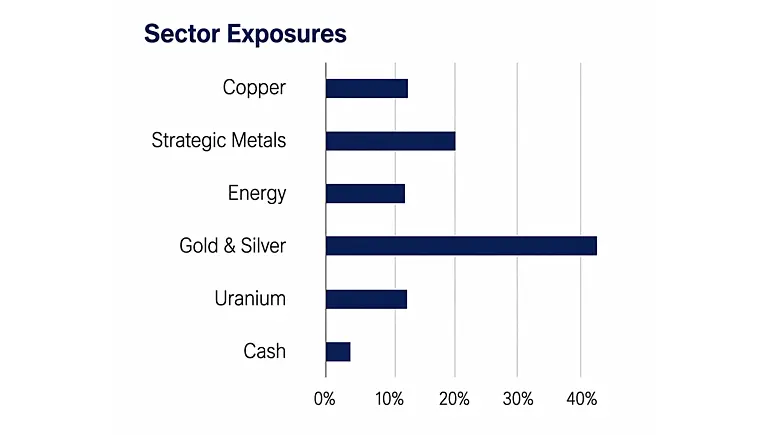
The fund’s stated mandate is investing in “commodities being positively impacted by global disruptions.” In FY26, global disruptions did their part. The Hormuz closure sent energy names surging, the Materials sector returned 47%, and a portfolio built by an ex-geologist was well-placed to capture both.

Manager Rick Squire brings over 25 years of experience in the resources industry. The NextGen Resources Fund has now made two back-to-back appearances on this list (28.45% in FY25, 31% in FY26). Rick was recently featured in our Meet the Manager series;
Top-performing funds over 5 years
The real test, as savvy investors know, is how a fund holds up over longer timeframes. Below, we have also included data on the top-performing Aussie equity funds over the last five years.
As you can see from the table below, six funds crossover on both the 1-year and 5-year lists.
| Fund name | 5-year performance |
| Ophir Opportunities Fund | 18.76% |
| L1 Capital Long Short Fund – Wholesale | 17.04% |
| Acorn Capital NextGen Resources Fund | 13.76 |
| L1 Capital Catalyst Fund | 13.12% |
| Ausbil MicroCap | 12.32% |
| Glenmore Australian Equities | 11.75% |
| Merlon Concentrated Australian Share Fund | 11.15% |
| Allan Gray Australia Equity Fund – Class B | 11.05% |
| RQI Australian Value Fund – Class A | 10.90% |
| Ausbil Australian SmallCap | 10.68% |
Three funds – L1 Capital Long Short, L1 Capital Catalyst, and Acorn Capital NextGen Resources – appear in the top 5 over both 1-year and 5-year periods.
Special mention to Ophir Opportunities Fund, which takes the top spot overall for best 5-year performance and only just fell out of the top-5 for FY26, coming in at number 6 on the list.