Katana has lifted cash to 24% amid concerns about global valuations, but Sala Tenna still sees compelling opportunities in two ASX names.
Please note this interview was recorded Tuesday, 28 July 2026
The more I have spoken with the top-performing managers of FY26, the more convinced I have become that beating the market requires a willingness to take concentrated bets when conviction is high.
That was certainly true of the Katana Australian Equity Fund, which delivered a market-beating 17.78% return in FY26.
One of the enduring reasons for the Fund’s success, according to Portfolio Manager Romano Sala Tenna, has been its willingness to take large active positions away from the benchmark.
Over the past 12 months, an outsized exposure to gold stocks, which at one stage comprised 12% of the portfolio, was a major driver of returns. With concentrated positions, however, comes greater scrutiny.
“It was front and centre in all our investment committee meetings. It’s a daily review because it is such a large active position,” Sala Tenna said of the Fund’s overweight exposure to gold.
“It’s important to note though that when we do take positions that large, there’s normally the intersection between top-down and bottom-up.
“From a top-down perspective, we could see the macro driving the gold price. And on a bottom-up, we’re seeing valuations, growth, and a lag in share prices.
“That’s what gives us the confidence to take those overweight positions.”
In the interview below, Sala Tenna explains what drove the Fund’s strong FY26 performance before outlining the opportunities and risks he believes investors should be watching over the year ahead. He also names two stocks he believes are particularly attractive today.
INTERVIEW SUMMARY
Looking offshore for the biggest risks
For the Katana Australian Equity Fund, FY26’s strongest contributors included Mineral Resources (ASX: MIN), GenusPlus(ASX: GNP) and Electro Optic Systems (ASX: EOS).
The Fund has taken some profits in Mineral Resources but retains a meaningful position, while it recently added to its holding in GenusPlus through a capital raising.
Electro Optic Systems, however, has been sold completely after a series of governance concerns, management missteps and growing competition in the defence technology sector prompted the Fund to exit at what Sala Tenna described as “a very nice profit.”
Despite managing Australian equities, Sala Tenna says his attention is increasingly focused offshore, where elevated US valuations are shaping how Katana is positioning the portfolio.
“We’re looking at US market valuations. The CAPE Shiller Index hit 41 and a half times. It’s only been there once before. That was in 2000, just before the dot-com crash.”
While he acknowledges earnings growth has supported valuations, he believes investor enthusiasm has become increasingly stretched.
“When you see things like SpaceX, if someone was to look back in 12 months’ time and say that was the proverbial ringing of the bell, you wouldn’t be surprised.”
That caution has translated into action. Katana has increased its cash weighting to around 24%, above its typical ceiling of 20%, and Sala Tenna says it could rise further before capital is redeployed.
“We do love reporting season every year,” he says. “We’ve often said that we should sell our entire portfolio at the end of July and buy back in August because you get so many opportunities.”
He expects cash levels could ultimately settle between 25% and 30% before the Fund begins putting money back to work as reporting season creates fresh opportunities.
Where Katana sees opportunity
While the Fund has become more defensive overall, Sala Tenna believes several structural themes still have years of growth ahead.
“We think some of the same beneficiaries from FY26 will continue,” he says.
“Companies that benefit from the implementation of AI at this stage of the cycle, energy transition, rewiring the nation and defence contractors.”
Healthcare is another area he believes has become increasingly attractive after an extended period of underperformance.
“It’s had probably the worst period I’ve seen in my 30 years of investing,” he says.
“That’s a good thing. Valuations have contracted dramatically, so we think that’ll recover.”
He also expects passive investment flows to remain an important influence on markets, even if they are never the primary reason Katana buys a stock.
“They’re never a primary driver for us to buy something, but it’s certainly a secondary consideration, increasingly so.”
Further out, Sala Tenna believes consumer discretionary companies could become attractive during the second half of FY27 as markets begin looking through any weakness in the Australian housing market.
“The market’s always forward-looking,” he says.
“I think by the time we get to the worst stage in the housing market, the market will be starting to look at the recovery and what that means for consumer spending.”
The risks keeping Katana cautious
Although optimistic about several long-term themes, Sala Tenna sees no shortage of risks over the next 12 months. The biggest remains the United States.
“If the US sneezes, we catch a cold,” he says.
“We’re seeing signs of overvaluation. We’re seeing signs of fatigue in some of the technical indexes.”
Closer to home, he is watching Australia’s housing market closely, arguing that residential property remains the country’s single biggest driver of household wealth and confidence.
“Approximately 56% of Australian household wealth is in the value of their homes,” he says.
“A 10% drop in the housing market is equivalent to a 50% stock drop in the stock market or a 30% drop in the value of superannuation assets.”
He is also concerned about domestic energy policy and its implications for inflation.
“In a country that has more molecules per capita than almost anywhere else in the world, it is mad that we are talking about the price of energy,” he says.
“Such has been government policy over the last little while that that’s where we find ourselves.”
Two stocks Katana likes today
Sala Tenna finished by highlighting two companies he believes remain well positioned despite broader market uncertainty.
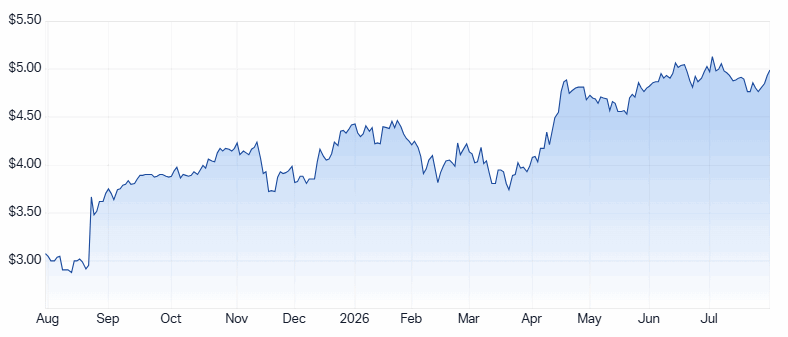
The first was Cuscal (ASX: CCL), which he says combines an attractive valuation, strong earnings visibility and a genuine competitive moat.
CCL 1-year chart. Source: Market Index
“It’s trading on 16 times earnings, got double-digit EPS growth the next two years locked in already, possibly three,” he says.
“It’s got a wide moat. We talk about moats and they’re genuinely rare. This has a wide moat.”
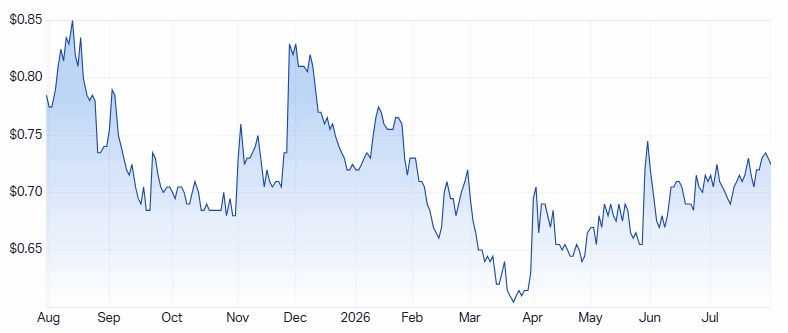
His second pick was HealthCo Healthcare & Wellness REIT (ASX: HCW), which he believes is materially undervalued following uncertainty surrounding Healthscope’s voluntary administration.
CCL 1-year chart. Source: Market Index
“It’s trading at about 0.5 to NTA, so 50 cents in the dollar,” he says.
“But these are absolutely critical assets. We’re talking hospitals, we’re talking healthcare centres.”
Sala Tenna sees three potential catalysts over the coming months: greater certainty around lease payments, the resumption of distributions once the Healthscope situation is resolved, and the possibility of HealthCo’s listed trust combining with its unlisted hospital fund.
“If that happens,” he says, “we could see a substantial contraction in the NTA discount.”